Photo essays
Queens of the backstreets
San Salvador, El Salvador
Although prostitution is not legal in El Salvador, dozens of street sex workers, wearing provocative miniskirts, hang out in the dirty streets close to the capital’s historic center. Sex workers of all ages are seen on the streets but a significant part of them are single mothers abandoned by their male partners. Due to the absence of state social programs, they often seek solutions to their economic problems in sex work. The environment of street sex business is strongly competitive and dangerous, closely tied to the criminal networks (street gangs) that demand extortion payments. Therefore, sex workers employ any tool at their disposal to struggle hard, either with their fellow workers, with violent clients or with gang members who operate in the harsh world of street prostitution.
Fear in El Salvador
El Salvador
During the last two decades, Central America has become the deadliest region in the world that is not at war. According to the UN statistics, more people per capita were killed in El Salvador than in Iraq, in recent years. Due to the criminal activities of Mara Salvatrucha (MS-13) and 18th Street Gang (M-18), the two major street gangs in El Salvador, the country has fallen into the spiral of fear, violence and death. Thousands of Mara gang members, both on the streets or in the overcrowded prisons, organize and run extortions, distribution of drugs and kidnappings. Tattooed armed young men, mainly from the poorest neighborhoods, fight unmerciful turf battles with their coevals from the rival gang, balancing between life and death every day. Twenty years after the devastating civil war, a social war has paralyzed the nation of El Salvador.
Digital geishas
Medellín, Colombia
With the traditional adoration of female beauty in Colombia, together with rapidly developing telecommunications technologies, the millennial generations of Colombian girls have turned Medellín… into a one of the world centers of webcam modelling, a interractive sex industry. Thousands of young women stream everyday via websites that allow the global viewers to personally interract with a model and to pay them for sexually related acts. The core of the show is always based on stripping, but cam models who have the ability of light conversation, flirting and entertaining the viewer may earn thousands of dollars a month. Sharing their whole lives in a constant interaction with their online clients, they have moved far beyond the borders of sexuality.
Men in the river stream
Cartago & Puerto Berrío, Colombia
Artisanal (unmechanised) sand mining is an ancient mining technique used to obtain sand for construction purposes. Depending on the natural conditions (strength of the stream, depth of the river etc.), together with the sand miners' physical condition, the material is extracted in metal buckets, either by standing on the river bottom and searching for sand by feet, or, diving up to 3-5 meters deep using a wooden plank with steps. In spite of the physically demanding work, a sand miner's daily salary does not exceed 15-20 US dollars. However, the sand miners are very proud of their profession, valuing their work freedom above all, and usually, as long as their health and strength permit, they keep facing the river stream.
Palo
Santiago de Cuba, Cuba
The Palo religion (Las Reglas de Congo) belongs to the group of syncretic religions which developed in Cuba amongst the black slaves, originally brought from Congo during the colonial period. Palo, having its roots in spiritual concepts of the indigenous people in Africa, worships the spirits and natural powers but can often give them faces and names known from the Christian dogma. Although there have been strong religious restrictions during the decades of the Cuban Revolution, the majority of Cubans still consult their problems with practitioners of some Afro Cuban religion.
Murderball
Bogota, Colombia
Wheelchair rugby, a full-contact team sport, was developed in Canada in 1977 under the name murderball. The game is played only by athletes with some form of disability in both the upper and lower limbs (quadriplegics). Attempting to score by carrying the ball across the goal line, four players from each team roughly crash into each other in specially designed armored wheelchairs. Although the team from Bogota is supported by a foundation (gear), quad rugby players, mostly coming from the remote, socially deprived neighbourhoods, often can not attend a training due to lack of funds for transportation. However, they still dream of representing Colombia at Rio 2016 Paralympic Games.
Free my soul
Mexico & Colombia
Exorcism is an ancient religious technique of evicting spirits, generally called demons or evil, from a person which is believed to be possessed. Although the formal catholic rite of exorcism is rarely seen and must be only conducted by a priest named by a local bishop, there are many Christian pastors and preachers all over Latin America (known as ‘exorcistas’) performing exorcism and prayers of liberation on believers, joined in nameless groups in unmarked home churches or gathered under minor Christian denominations, dispersed in urban outskirts.
Sugar cane cutters
Valle del Cauca, Colombia
The Cauca River valley is the booming centre of agriculture and sugar cane cultivation in Colombia. Although the main part of the crop is still refined into a sugar, the global demand of biofuel and ethanol has intensified the sugar cane production in the last years. 85 percent of Colombia's cane crop is still harvested the manual way, employing approximately 30,000 workers. Working six days a week, under harsch labor conditions, the sugar cane cutters earn $4 for every ton of cane they cut, with no access to social benefits due to the tricky system of intermediary contractors and cooperatives.
Shark slaughter
Manta & Puerto López, Ecuador
Every morning, hundreds of shark bodies and thousands of shark fins are sold on the Pacific coast of Ecuador. Most of the shark species fished in Ecuadorean waters are considered as “vulnerable to extinction” by the World Conservation Union (IUCN). Although fishing sharks barely sustain the livelihoods of many poor fishermen on Ecuadorean coast, at the end of the shark fins business chain in Hong Kong they are sold as the most expensive seafood item in the world. The shark fins are primarily exported to China where the shark's fin soup is believed to boost sexual potency and increase vitality. Rapid economic growth across Asia in recent years has dramatically increased demand for the shark fins and has put many shark species populations on the road to extinction.
Warrior queens
Mexico City, Mexico
Lucha libre, literally “free fight” in Spanish, is a unique Mexican sporting event and cultural phenomenon. Based on aerial acrobatics, rapid holds and the use of mysterious masks, Lucha libre features the wrestlers as fictional characters (Good vs. Evil). Given the popularity of Lucha libre in Mexico, many wrestlers have reached the cult status, showing up in movies or TV shows. However, almost all female fighters are amateur part-time wrestlers or housewives. Passing through the dirty remote areas in the peripheries, listening to the obscene screams from the mainly male audience, these no-name luchadoras fight straight on the street and charge about 10 US dollars for a show. Still, most of the young luchadoras train hard and wrestle virtually anywhere dreaming to escape from the poverty and to become a star worshipped by the modern Mexican society.
Comandante and the people
Cuba
During the Cuban Revolution, an armed rebellion at the end of the 1950s in Cuba, most of the revolutionary leaders started as no-name soldiers fighting in the jungle. As those young men risked unselfishly their lives in the name of the country's better future, soon they gained the hearts and genuine support of all poor Cubans. Although the revolutionary leaders, after taking over the power, became autocratic rulers holding almost absolute power and putting the opposition in jail, for some reason Cuban people have never stopped to worship Fidel Castro, Che Guevara, Raul Castro and others. Cubans hang their photos and portraits on the wall in homes, shops and working places even they don't have to. The people of Cuba love their heroes.
Forgotten exodus
Colombia
With nearly fifty years of armed conflict, Colombia has the highest number of civil war refugees in the world. During the last ten years of the civil war more than 3 million people have been forced to abandon their lands and to leave their homes due to the violence. Internally displaced people (IDPs) come from remote rural areas, where most of the clashes between leftist guerrillas FARC-ELN, right-wing paramilitary groups and government forces takes place. Displaced persons flee in a hurry, carrying just personal belongings, and thus they inevitably end up in large slums of the big cities, with no hope for the future.
Semana Santa Cora
Nayarit, Mexico
The annual week-long Easter festivity (called “La Judea”), performed in the rugged mountain country of Sierra del Nayar, merges indigenous tradition (agricultural cycle and the regeneration of life worshipping) and animistic beliefs with the Christian dogma. Each year in the spring, the Cora villages are taken over by hundreds of wildly running men. Painted all over their semi-naked bodies, fighting ritual battles with wooden swords and dancing crazily, they perform demons (the evil) that metaphorically chase Jesus Christ, kill him, but finally fail due to his resurrection. La Judea, the Holy Week sacred spectacle, represents the most truthful expression of the Coras' culture, religiosity and identity.
Hunger and Rage
Port-au-Prince, Haiti
Although the Caribbean islands are widely considered as a holiday paradise, Haiti evokes a hell and a disaster rather than anything else. The overall situation on Haiti gets worse every year and the extreme, hardly imaginable poverty hits more and more people. The Haitian economics is paralysed, there is no infrastructure, no food supplies, the population suffer from hunger, social and living conditions in Haitian slums (e.g. Cité Soleil) are a human tragedy. There seems to be no way out of this misery. Haitian administration is (and always has been) higly corrupted, misappropriation of public funds is common. MINUSTAH (Blue Helmets installed on Haiti by the UN in 2004) substitute the police therefore they are generally not welcomed by the Haitian population. The rage grows and the tension continues with undiminished strength.
Random photoblog posts
Women wrestler (Mexico City, Mexico)

Sand miners (Cartago, Colombia)
Girls from Ciudad Bolívar (Bogota, ...
Street football in the Colombian Pacific ...
Blízko svých mrtvých (stát Michoacán, ...
Tzotzil Maya man (San Cristóbal de las ...
Emerald cutting workshop (Bogota, ...
„Are you know Amazonia?“ (Manaus, ...
Plastic Art (Cali, Colombia)
Kamentsa shaman (Sibundoy, Colombia)
Hot afternoon in Havana (Havana, Cuba)
Kamentsa beauty (Sibundoy, Colombia)
Transsexual women in El Bronx (El Bronx, ...
Las Catrinas (Día de Muertos)ico City, ...
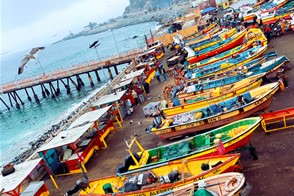
Fishermen of Quintero (Quintero, Chile)
A sex worker & a cat (San Salvador, El ...
African roots (Cartagena, Colombia)
Carnival in favela (Rocinha, Rio de Janeiro, ...
A man talks to a nun (Santander de ...
Tvůrci karnevalu (Rio de Janeiro, Brazílie)
Selected publications
Water scarcity in Die Zeit

Vintage letterpress print shop on BBC
Selaron's Stairs in Los Angeles Times
Wheelchair rugby… on CNN
Fear in El Salvador on Al Jazeera
Contraband in Time
El Chepe train in The Washington Post
Santa Muerte in The Times
Selaron's Stairs in El País
Chasing the homeboys in Daily Mail
El Chepe train in Vogue
Warrior Queens in ABC News
Selaron's… in National Geographic
Swamp people in GEO
Santa Muerte in Süddeutsche Zeitung
Santa Muerte in The Guardian
Boxing dreams in ESPN Deportes
Swamp people in Science
Carnival in Santiago de Cuba in Vanity Fair
La Saline market in The Economist
Vybrané reportáže & fotoreportáže
Voda nad zlato (Peru)
Tetované srdce (El Salvador)
Hořká chuť cukru (Kolumbie)
Zlato pod nebem (Peru)
Hold strojům (Kolumbie)
Královny bez korunek (Mexiko)
Muži v proudu řeky (Kolumbie)
Zoo Havana (Kuba)
Selarónovy schody (Brazílie)
Démoni z Nayaritu (Mexiko)
Setkání ve tmě (Peru)
Exorcista (Mexiko)
Svatá Smrt (Mexiko)
Útěk bez konce (Kolumbie)
Teče krev, teče krev (Kuba)
Sluneční město (Haiti)
Comandante a lid (Kuba)
Omega 13 (Venezuela)
Harraga (Maroko)
Život supa (Nikaragua)